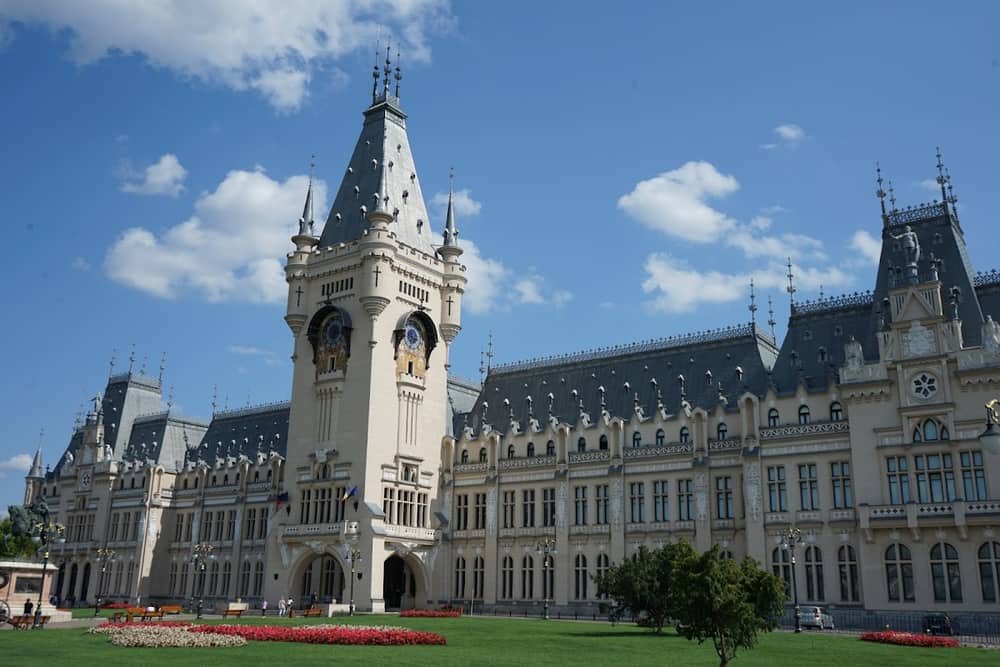
It is not a palace in the usual sense. It is a twentieth-century administrative building in neo-Gothic style, raised on the site of the old princely court, which today functions as a museum complex. That confusion is why many visitors arrive with the wrong expectations and leave disappointed: they are looking for princely apartments and they find museums.
What it actually is
The building has 298 rooms and roughly 36,000 square metres. It is therefore not one sight but four — the "Moldova" National Museum Complex gathers the history museum, the art museum, the ethnographic museum and the science and technology museum under one roof.
That changes how you plan entirely. A sight is visited. Four museums in one building are chosen between.
The four museums, briefly
The Museum of Moldavian History supplies the context for everything else in the city: why Iași was the capital for three centuries, what 1859 meant, and how it became a wartime capital in the First World War. If you have time for one and want to understand the city, this is it.
The Art Museum is Romania's oldest picture gallery. Worth it especially if nineteenth-century Romanian painting interests you — the period when Iași was still a place where cultural decisions were made.
The Ethnographic Museum of Moldavia is the best choice for someone arriving from outside Romania. It explains the region, not just the city.
The "Ștefan Procopiu" Science and Technology Museum is the one that works best with children — objects, mechanisms, things that move. We recommend it in the family guide too.
The tower and the clock
The tower clock plays the Hora Unirii. That is not a tourist legend but a genuine feature of the building, and one of the few things about Iași that even people who have never been here recognise. You can hear it from the square, so you do not need to go in to catch it.
Planning the visit
With two hours: the central hall plus a single museum, chosen by interest. Do not attempt two.
With half a day: two museums, with a break between them in Palas Garden, which is right alongside.
With a full day: all four, in the knowledge that the last will be walked through at speed. Museum fatigue is real and it lands around hour three.
Tickets are sold individually or as a package, and hours change seasonally — some days are closing days. Check with the complex directly before you set out; we do not publish museum timetables.
What is nearby
The Palace sits at the southern end of the central axis, which makes it a good starting point rather than only a destination.
- Palas — immediately behind: the public garden, restaurants, terraces. The most comfortable spot in the city for a post-museum break.
- Trei Ierarhi — a few minutes on foot, along the axis towards Piața Unirii.
- The Natural History Museum — also minutes away, one of the oldest museums of its kind in Romania.
What stood here before
The building sits on the site of the old princely court of Moldavia — the seat of power through the three centuries when Iași was the capital. The present palace, raised in neo-Gothic style in the early twentieth century, was conceived as an administrative and judicial building rather than a museum; the museum function came later.
That context explains a common puzzlement: why a building that looks medieval is in fact modern. Neo-Gothic is a twentieth-century stylistic choice, a quotation of the past rather than the past itself. The city's four architectural layers are set out in the architecture of Iași.
Accessibility
The building is large and has stairs. If you are coming with a pushchair or have difficulty walking, ask at the desk about lift access before buying a ticket for an upstairs museum — not all areas are equally accessible, and the situation changes with whatever works are under way.
Photographing it
The square-facing façade photographs best early in the morning or at sunset, when the light falls sideways and picks out the neo-Gothic detail. At midday the overhead sun flattens the façade completely — which is why most tourist photographs of the Palace look flat.
Context
For the building's place in the city's history, see the architecture of Iași and the history of the city. For everything else, the full list.