The economy of Iași can be explained in a single sentence: it is a city that produces thousands of graduates a year and, after 1990, worked out how to keep them at home.
The industrial inheritance
The communist period industrialised the city by force, and the housing districts built then — Nicolina, Alexandru cel Bun, Dacia — went up for the workers of those platforms. After 1989 much of the heavy industry contracted.
What remains and works:
- ArcelorMittal — metallurgy, one of the area's large industrial employers.
- Antibiotice SA — a long-established pharmaceutical manufacturer and one of the city's emblematic companies.
IT
The IT sector has been the engine of the last two decades. Iași hosts operations of companies such as Amazon, AMD, Oracle and Bitdefender, alongside a local ecosystem of software and services firms.
The explanation is not mysterious. It is a combination of three things:
- The flow of graduates. "Gheorghe Asachi" Technical University and the computer science faculties of UAIC turn out engineers and programmers continuously.
- Costs below Bucharest and Cluj. In both salaries and property, the city was for a long time the cheaper alternative.
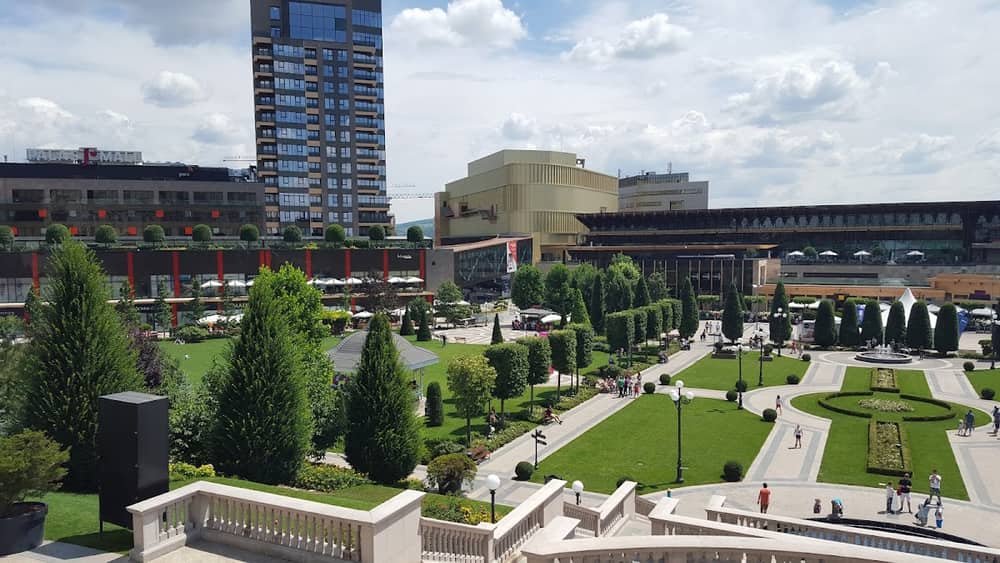
- Office infrastructure. The Palas development, built over the last decade next to the Palace of Culture, brought class A office space, retail and hotels into a single central perimeter — which changed the map of the city's working day.
Healthcare as an industry
Iași is the largest medical centre in Moldavia. Its teaching hospitals — among them the "Sf. Spiridon" County Emergency Clinical Hospital, the region's largest medical unit — serve patients from several counties. Together with "Grigore T. Popa" University, which has around 10,400 students and a large international student body, healthcare is a major employer and a real source of income for the city.
Universities as an economy
With more than 60,000 students, the universities are not merely educational institutions but an economic sector in their own right: rents, catering, transport, retail, events. The effect shows directly in the city's annual rhythm, which empties in July and August and refills in October. See the population of Iași.
The metropolitan zone
An important economic phenomenon of the last two decades: the surrounding communes — Miroslava, Valea Lupului, Rediu, Bârnova, Ciurea — have grown explosively. 452,732 people live in the Iași Metropolitan Zone, against 271,692 in the municipality. The gap means daily commuting, pressure on the road network, and a property market that has moved outside the city.
What it means for a visitor
- Prices below Bucharest and Cluj, for food and accommodation.
- Business-travel demand — hotels in the centre and the Palas area work with corporate clients during the week, which means weekends are sometimes cheaper.
- A centre that works during the day, not only in the evening — the effect of the Palas offices.
What was lost and what remains
The communist period industrialised the city by force, and the population multiplied several times over in three decades. The housing quarters raised then — Nicolina, Alexandru cel Bun, Dacia, Tătărași — still house most of the city. They were built for the workers of industrial platforms that contracted significantly after 1989.
What remains and works are a few solid points: ArcelorMittal in metallurgy and Antibiotice SA in pharmaceuticals — one of the city's emblematic companies.
Why IT took root here and not elsewhere
Three factors aligned, in this order:
- The graduate flow. The technical university and the computer science faculties produce engineers continuously. More than 60,000 students in the city means a labour reserve few Romanian cities have.
- Costs below Bucharest and Cluj. In salaries and property, Iași was for a long time the cheaper alternative — the main argument when opening a development centre.
- Office space. The Palas development, built over the last decade right next to the Palace of Culture, brought class A offices into the centre. Before that, the supply was poor.
What we do not claim
We do not publish headcounts per company, average IT salaries or shares of local GDP. These change from year to year, have no single verifiable public source, and — quoted wrongly — distort a serious discussion about a city's economy.
What is verifiable and stays true is the structure: universities, healthcare, IT, industry — in that order by number of employees.
In short
- The universities are the main industry: over 60,000 students across five state universities.
- IT: operations of companies such as Amazon, AMD, Oracle and Bitdefender, plus a local ecosystem.
- Industry: ArcelorMittal in metallurgy, Antibiotice SA in pharmaceuticals.
- Healthcare is an economic sector in its own right — Moldavia's largest medical centre.
- The Palas development brought class A offices into the centre, changing the rhythm of the working day.
- The metropolitan zone: 452,732 inhabitants, commuting into the city daily.
- For visitors: prices below Bucharest and Cluj, and weekends often cheaper than weekdays.
What was lost and what remains
The communist period industrialised the city by force, and the population multiplied several times over in three decades. The housing quarters raised then — Nicolina, Alexandru cel Bun, Dacia, Tătărași — still house most of the city. They were built for the workers of industrial platforms that contracted significantly after 1989.
What remains and works are a few solid points: ArcelorMittal in metallurgy and Antibiotice SA in pharmaceuticals — one of the city's emblematic companies.
Why IT took root here and not elsewhere
Three factors aligned, in this order:
- The graduate flow. The technical university and the computer science faculties produce engineers continuously. More than 60,000 students in the city means a labour reserve few Romanian cities have.
- Costs below Bucharest and Cluj. In salaries and property, Iași was for a long time the cheaper alternative — the main argument when opening a development centre.
- Office space. The Palas development, built over the last decade right next to the Palace of Culture, brought class A offices into the centre. Before that, the supply was poor.
What we do not claim
We do not publish headcounts per company, average IT salaries or shares of local GDP. These change from year to year, have no single verifiable public source, and — quoted wrongly — distort a serious discussion about a city's economy.
What is verifiable and stays true is the structure: universities, healthcare, IT, industry — in that order by number of employees.
Frequently asked questions
Which large companies are in Iași?
From industry, ArcelorMittal and Antibiotice SA. In IT, the city hosts operations of companies such as Amazon, AMD, Oracle and Bitdefender, plus a local ecosystem of software firms.
Why did IT develop in Iași?
Through the combination of a steady flow of graduates from the technical university and the computer science faculties, costs below those in Bucharest and Cluj, and the arrival of modern central office space in the Palas development.
Who is the largest employer in Iași?
The public sector — the universities and teaching hospitals — accounts for the largest body of employees, followed by IT and the remaining industry.
How large is the Iași metropolitan area?
452,732 inhabitants at the 2021 census, against 271,692 in the municipality — close to 60% of the county's population.
Is Iași good for business travel?
Yes. It has an airport 8 km from the centre, hotels in the Palas area and the centre, and conference space. Weekends are often cheaper than weekdays.